The short answer
The Rolf Method of Structural Integration is the original bodywork Dr. Ida Rolf developed and taught for roughly forty years. Rolfing is a registered trademark. The hands-on work is substantially the same. The difference is which organization certified the practitioner — and how closely that practitioner’s training follows Dr. Rolf’s original curriculum.
If you book a session with a graduate of the Guild for Structural Integration, you’re receiving the Rolf Method as Dr. Rolf taught it, passed down from teachers who studied directly with her. If you book with a graduate of the Dr. Ida Rolf Institute, you’re receiving Rolfing — also descended from Dr. Rolf but taught through a separate institutional lineage since 1989.
Both are Structural Integration.
Who was Dr. Ida P. Rolf?
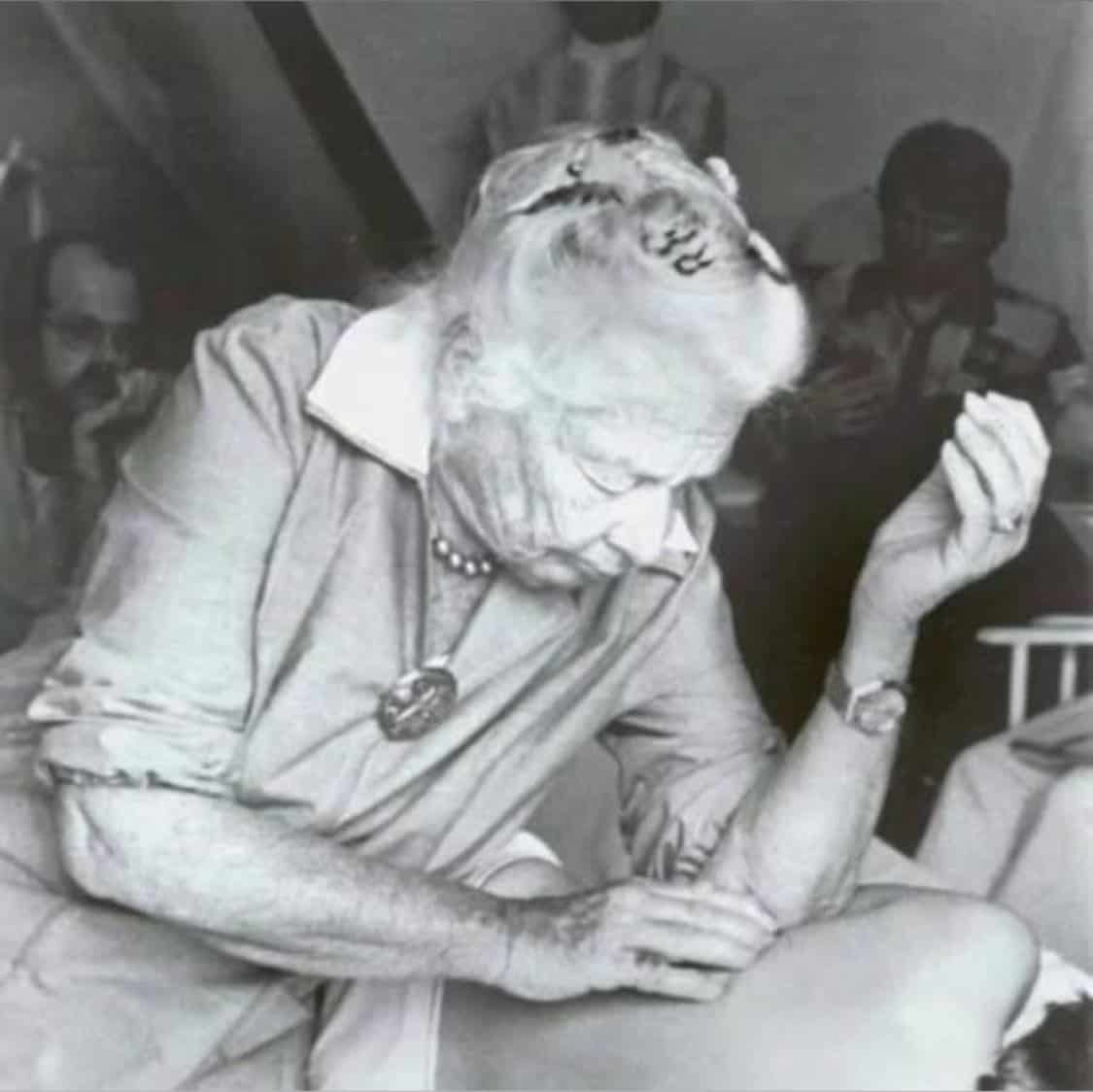
Dr. Ida Rolf (1896–1979) was an American biochemist who earned her PhD at Columbia University in 1920, an unusual credential for a woman of her era, and spent the next five decades developing the hands-on system now known variously as Rolfing, Structural Integration, or the Rolf Method.
Her central insight was that the human body is organized by its fascial network — the connective tissue that wraps every muscle, bone, and organ. Work that network systematically, in gravity, and you can create structural balance and lasting function. By the late 1960s she was teaching at Esalen Institute in Big Sur. In 1971 she founded her own school to train practitioners in her method. She named it the Guild for Structural Integration: Guild because she saw the work as a craft and the training as an apprenticeship in the old sense of the word, artisan to apprentice; and Structural Integration, because that was the name she had chosen for her work.
The word “Rolfing” was a nickname her students coined, which she initially resisted and later accepted as the popular name for the work.
Why are there two names for the same work?
To understand the two names, you have to go back to 1971. When Dr. Rolf founded her school, she named it the Guild for Structural Integration. That was the school’s original name, chosen by her, reflecting her view of the work as a craft.
In the years that followed, the school was renamed the Rolf Institute of Structural Integration. Accounts among Dr. Rolf’s direct students differ on the exact timing and mechanism — some point to Dr. Rolf’s own decision to align the school’s name with the Rolfing trademark she had registered (since “Structural Integration” was too generic a term to trademark), others to a Board decision around the time of her death in 1979. Either way, the school continued under that new name and brand.
In 1989, a decade after Dr. Rolf’s passing, a group of her senior teachers left the Rolf Institute over differences about how her work should be taught, organized, and evolved. The four who founded the new organization were Emmett Hutchins, Peter Melchior, Neal Powers, and David Davis. Two of them, Emmett Hutchins and Peter Melchior, were the students Dr. Rolf had personally selected to open her school and teach her work in the first place, back in 1971. Neal Powers was also trained by Dr. Rolf, and David Davis was trained by Emmett Hutchins and Neal Powers.
Together they founded a new organization to preserve and transmit her original curriculum — the “Recipe,” as she called it — in the form she had finalized in her last years of teaching. They named it after the school’s original name: the Guild for Structural Integration.
So: two schools, one source, one original name. Both trace directly back to Dr. Rolf. The Guild for Structural Integration carried the name she first gave the school in 1971 and taught the curriculum closest to the form she finalized — until it closed its doors in 2023. The lineage now lives in its graduates. The Institute, now named the Dr. Ida Rolf Institute, carries the Rolfing brand and a curriculum that has continued on its path in the decades since her death.
This isn’t a story of one side being right and the other wrong. It’s a story of how a body of work, after its founder is gone, can be carried forward in more than one direction — and how a small group of people chose to carry it forward exactly as she taught it.
What the trademark actually protects
Rolfing and Rolfer are registered service marks owned by the Dr. Ida Rolf Institute. In plain language:
Only practitioners certified by the Institute can market themselves as a “Rolfer” or offer “Rolfing” as their service. Everyone else — including graduates of the Guild for Structural Integration — must describe their work by a different name. The standard term is Structural Integration, and for Guild graduates specifically, the Rolf Method of Structural Integration.
The trademark does not protect the bodywork itself. Anyone appropriately trained can perform structural integration; they simply can’t call it “Rolfing” in their marketing. And descriptive, comparative, or educational use of the terms — like this article — is protected under a legal doctrine called nominative fair use. Non-Institute practitioners can reference the trademarks in these contexts; we just can’t claim the marks as our own service line.
Is the Rolf Method the same bodywork as Rolfing?
In the session room, largely yes. Both follow the 10-Series — ten sessions that systematically open and reorganize the body’s fascia from the surface inward. Both use Dr. Rolf’s principles of working in gravity, reading structure as a whole, organizing it around the Line — the central vertical axis Dr. Rolf identified as the goal of this work — and aiming at lasting change rather than symptomatic relief.
Where they diverge is in curriculum emphasis and institutional culture.
Guild-trained practitioners typically receive training very close to the Recipe as Dr. Rolf standardized it. The orientation is “the Recipe is the teacher” — learn her specific sequence with minimal modification, let it do the work, and add your own voice only once you’ve internalized hers.
Institute-trained practitioners learn a curriculum that has continued on its path, since Dr. Rolf’s death, incorporating developments in fascial research, movement education, and adjacent disciplines.
Neither approach is objectively better. A skilled practitioner from either school will produce excellent results. A less-skilled practitioner from either school will not. The label tells you something about the lineage; it does not tell you everything about the quality of their hands.
What “second-generation” means
Here I’ll speak personally. I’m a graduate of the Guild for Structural Integration, class of 2007, with Advanced Certification in 2012. My teachers — Emmett Hutchins and Neal Powers — were trained directly by Dr. Rolf. They were in the room with her. They studied the Recipe directly from its author and spent their careers transmitting it without dilution. (I also want to acknowledge David Davis, also one of my teachers, who as I mentioned above, was trained by Emmett Hutchins and Neal Powers.)
That makes me a second-generation practitioner: one teacher removed from Dr. Rolf’s own hands. It’s a claim a shrinking number of practitioners can honestly make, because Dr. Rolf’s direct students are aging out of teaching.
This doesn’t mean I’m a better practitioner than a newer Institute graduate. It means my training followed a specific lineage — Dr. Rolf, her direct students, me — with no intermediate generation between us. For clients who care about authenticity of lineage, that matters. For clients who simply want their low back to stop hurting, what matters is whether the work works, and that question is answered by results and reviews, not by a credential.
Legally, I am not a Rolfer. Technically — in the sense of training, tradition, and bodywork — I am a second-generation practitioner of the work Dr. Ida Rolf developed.
How to choose a practitioner, regardless of label
Don’t choose on the brand name. Choose on these:
Certification from a legitimate school. The Dr. Ida Rolf Institute and the Guild for Structural Integration (which closed in 2023) were the two lineage-holders for Dr. Rolf’s original work. Guild graduates remain in active practice. Other schools exist — the New School of Structural Integration, Kinesis Myofascial Integration (KMI), and others — and produce good practitioners; just verify the training.
Years in practice. Experience deepens the work. That said, the Recipe is the teacher. A well-trained beginner who trusts the sequence will deliver real results; trust the process.
Advanced certification. An optional second level of training offered by the Institute, and historically by the Guild as well, usually completed several years into practice.
Reviews and word of mouth. This work is ultimately embodied. Clients who’ve completed a full 10-Series can tell you what it felt like during and, more importantly, what held afterward.
Fit. Some practitioners are especially good with athletes, others with chronic pain, others with posture or scoliosis. A brief phone consultation tells you a lot.
For a fuller discussion of what to look for when evaluating a Rolfing practitioner, see my post on how to choose a Rolfing practitioner in Los Angeles.
My position
I describe my work as the Rolf Method of Structural Integration. I don’t call myself a Rolfer because I’m not legally entitled to, and I respect the trademark. I use the word “Rolfing” descriptively and comparatively because most people searching for this work don’t yet know of the different schools, and I don’t want language gatekeeping to stand between someone in pain and the help they’re looking for.
If you’ve landed here searching for Rolfing in Los Angeles or Rolfing in Santa Monica, I want you to know exactly what you’d be getting with me: the original 10-Series as Dr. Rolf taught it, from a second-generation practitioner trained in her direct lineage, in practice since 2007. Whether you ultimately book with me or with a Rolfer across town, the work will be close cousins. The question is fit, experience, and trust.
Book Your First Session in Santa Monica
Frequently asked questions
Is the Rolf Method the same as Rolfing? The bodywork is substantially the same — both follow Dr. Ida Rolf’s 10-Series. The names differ because of an institutional split in 1989. Rolfing is the trademarked term owned by the Dr. Ida Rolf Institute. The Rolf Method of Structural Integration is the name used by graduates of the Guild for Structural Integration — which carries the original name Dr. Rolf gave her school in 1971 and taught her original curriculum until its closure in 2023.
Why isn’t Craig Dunham called a Rolfer? Rolfer is a registered service mark of the Dr. Ida Rolf Institute. Only Institute graduates are licensed to use it. Craig is a graduate of the Guild for Structural Integration and describes his work as the Rolf Method of Structural Integration. He is a second-generation, certified Advanced practitioner of Dr. Rolf’s work.
Who was Dr. Ida Rolf? Dr. Ida P. Rolf (1896–1979) was an American biochemist with a PhD from Columbia University who developed Structural Integration — the bodywork system now also known as Rolfing. She taught for roughly forty years and in 1971 founded her own school, originally named the Guild for Structural Integration and later renamed the Rolf Institute.
What is the 10-Series? The 10-Series is Dr. Rolf’s standardized sequence of ten Structural Integration sessions. Sessions 1–3 open the superficial fascia, 4–7 address the core and deeper structures, and 8–10 integrate the whole body so the changes hold.
Who refounded the Guild for Structural Integration in 1989? The Guild was refounded in 1989 by Emmett Hutchins, Peter Melchior, Neal Powers, and David Davis. Emmett Hutchins and Peter Melchior were the two students Dr. Ida Rolf had personally selected to open her school and teach her work; Neal Powers is of the same direct lineage. David Davis was trained by Emmett Hutchins and Neal Powers. They named the new organization after the school’s original 1971 name.
Is one lineage better than the other? Neither lineage is objectively better. Both produce skilled practitioners. The difference is in curriculum emphasis — the Guild taught Dr. Rolf’s original Recipe with minimal modification; the Institute has changed its curriculum over time. Choose on the practitioner, not the brand.
Can a practitioner from another school do this work? Yes. Several legitimate schools teach Structural Integration outside the Institute–Guild lineage, including the New School of Structural Integration and KMI. What matters is the depth of training and the skill of the practitioner.
What’s the difference between Rolfing and deep tissue massage? Rolfing and the Rolf Method are structural, whole-body work aimed at lasting change in posture and function — organized around the 10-Series. Deep tissue massage is typically a single-session modality aimed at local muscular release. The two are different in goal, approach, and in how they feel on the table. Clients who’ve experienced both consistently describe Structural Integration as slower, more precise, and oriented to the whole body rather than to a sore spot.
Rolfing and Rolfer are registered service marks of the Dr. Ida Rolf Institute. Craig Dunham is an Advanced practitioner and 2007 graduate of the Guild for Structural Integration and practices the Rolf Method of Structural Integration in Los Angeles and Santa Monica.