Dr. Ida Rolf believed that we are still evolving as a species — that humans have not yet come fully upright, and that our low back is the part of us that pays the price. The World Health Organization estimates that up to 85% of people will experience low back pain in their lifetime. If you’ve been searching for “Rolfing for low back pain” in Los Angeles or Santa Monica, you are not alone.
After more than 19 years of practice in Santa Monica, here is what I can — and can’t — tell you about how the Rolf Method works with this.
A quick note on terminology
You searched for “Rolfing.” That is the term most people know, and I use it because it’s how the work is found. Rolfing is a trademark of the Dr. Ida Rolf Institute. My formal training is in the Rolf Method of Structural Integration, taught at the Guild for Structural Integration. The Guild was known for teaching this work unchanged from how Dr. Rolf taught it. If you want the full story, I wrote a longer post about it here: Rolf Method vs Rolfing: An Advanced Practitioner’s Guide.
For the rest of this post I’ll use “Rolfing” and “Structural Integration” interchangeably, because that is how most clients arrive at the work.
What this post is, and isn’t
I want to be clear upfront, because most articles online about Rolfing and back pain overpromise.
If you are in acute low back pain right now — the kind that came on suddenly, or that has you unable to stand up, or that radiates down a leg with new numbness or weakness — the Rolf Method is not your first stop. See your doctor or a physical therapist. Acute injuries belong in the world of medical care.
The Rolf Method is not therapy. I don’t fix things — even if some practitioners say they do. That is not Structural Integration. Rolfing is an educational model. It is about creating awareness in the body so that the structure can integrate and support itself.
This post is about the other category: chronic low back pain. The kind that has been around for months or years, that comes and goes, that you have already worked with through other modalities, that has settled into how your body holds itself. That is where the Rolf Method shines.
Dr. Rolf’s view: the back is the consequence, not the cause
The body is a stress distribution system. When the system is organized around the Line — the central vertical axis Dr. Rolf identified as the goal of this work — stress flows through it evenly. When it isn’t — when the pelvis is tilted, the hips are tight, the breath is shallow, the feet have collapsed, the thoracic spine is locked — that stress has to go somewhere.
It often ends up in the most mobile part of the spine you have left: the lumbar spine.
This is why, in this work, the back is rarely the source. The back is usually the consequence of what is happening elsewhere in the structure. If you have been chasing your low back pain for years and feel like nothing has lasted, the reason may be that you have been chasing the wrong place.
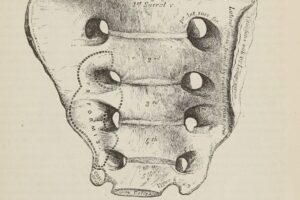
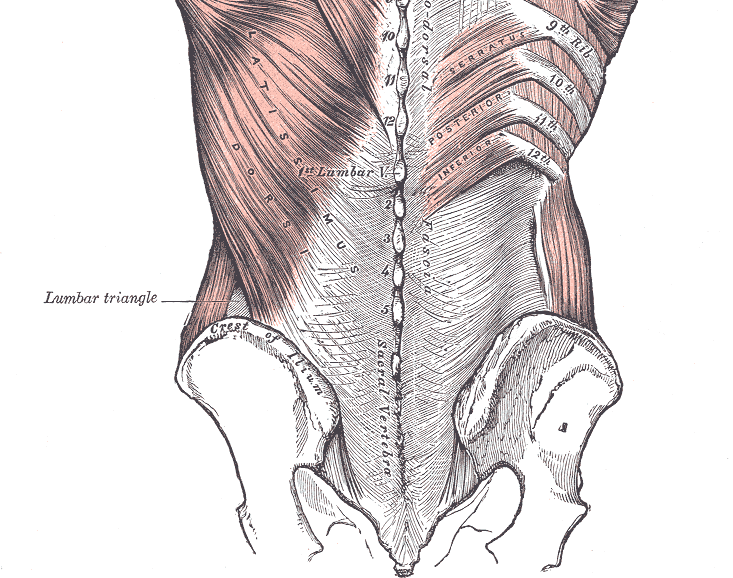
The illustration at the top of this post — from Henry Gray’s “Anatomy of the Human Body” (1918) — shows part of why: the back is held by a network of muscles connecting to the vertebral column, not a single point. It is a useful reminder that the back is not a thing. It is a relationship.
The pattern question
Something that surprises many clients: the structural patterns we associate with low back pain show up in plenty of bodies that are not in pain at all. The patterns are the same. What differs is whether the pattern has surfaced as pain yet — or whether it will, eventually, when something tips the system over.
That has two implications.
First: your pain is not the fact of your structure. It is the current expression of it. The body that is in pain today and the body that is not in pain are not as different as we imagine. They are carrying related patterns. One is just speaking up.
Second: working with someone who has no pain right now can still create meaningful structural change. The underlying pattern is still there. Structural Integration is not strictly a response to symptoms — it is a response to structure.
Why chronic low back pain responds to this work
The Rolf Method does not chase the pain. It does not just zero in on the spot that hurts. That is one of the things that distinguishes it from massage and from most therapeutic modalities.
Instead, the work moves around the structure — addressing the relationships between feet, pelvis, ribs, shoulders, breath, and head — and over the course of a session or a series, the body begins to feel something it may not have felt in a long time: support, connection, a sense of lift instead of strain.
When that happens, the experience of low back pain often changes. Not always immediately. Not always by being “fixed.” But in the way you stand, in the way you breathe, in the way you carry yourself through your day, the load on the low back begins to redistribute — because the rest of the structure has come back online and started doing its job again.
That is the beauty of the Rolf Method for chronic low back pain. It does not aim at the pain. It builds the resilience that makes the pain less necessary.
(I have written more about this distinction in my post on chronic pain, which goes into the principle in more depth.)
What I wish more people in low back pain understood
I wish more people saw their body as a whole, instead of just a back that hurts.
Doing the same thing repeatedly — sitting in the same chair, training the same way, wearing the same shoes, sleeping in the same position — at some point stops working. Treating only the source of pain again and again, at some point, stops working too. The body adapts, and then the adaptation itself becomes the problem. Low back pain is often the moment when the system tells you: this no longer fits.
Seeing the body as a whole is not a metaphor. It is a practical reframe. If your low back hurts and your hip flexors are short, your thoracic spine is locked, and the arches of your feet have fallen or are rigid — those things are not separate problems. They are one problem with several names.
What about my doctor, my chiropractor, my physical therapist?
I have worked with many clients who are simultaneously seeing a physical therapist or a chiropractor on a regular basis. I do not have formal working relationships with PTs, chiropractors, or orthopedists, but I have no objection to clients working in parallel, as long as your medical team is aware that we are working together, and it is medically appropriate for me to work with you.
Here is how I think about the ordering:
-
- In acute pain? See a doctor or a physical therapist first
-
- Past the acute phase, but still feeling vulnerable or pattern-locked? That is the moment when this work can begin to integrate the structure, so that the next acute episode is less likely.
-
- Chronic, recurring, low-grade? This is the population I see most often, and the population the Rolf Method is best positioned to help.
Rolfing is rarely a first stop for an injury. It is often a meaningful stop after the injury is addressed.
What a session looks like for someone with chronic low back pain
If you have never had a Rolfing session before, I wrote a separate post about what to expect — what to wear, what the work feels like, the difference between a strong sensation and a painful one. You can read it here: What to Expect in Your First Rolfing Session in Los Angeles.
For someone whose presenting issue is chronic low back pain, the work does not begin in the back. It begins with how your breath moves. How your hips balance. How you stand. Where your weight goes. How your feet meet the floor. The first session is more about the structure as a whole than about the place that hurts.
That can be hard to accept at first, especially if pain is what brought you in. But it is the principle. The back will respond when the rest of the structure stops asking it to do everyone else’s job.
A note on the 10-Series
For chronic low back pain, a single session can offer relief — but lasting change usually comes from a series. The 10-Series was designed precisely to address the body region by region, building toward integrated structure rather than localized fixes. Most clients with chronic patterns benefit from working through at least the first three sessions, often the full ten. You’ll know after the first session if this is right for you.
You are not committing to ten sessions when you book a first one. But it is worth knowing that the larger arc exists, because the deepest changes happen across it.
Practical logistics
Where. My office is in Santa Monica, easily accessible from the Westside, West Los Angeles, Brentwood, Venice, Pacific Palisades, Mar Vista, and Culver City.
Length. I schedule 90 minutes total — about an hour of hands-on work, plus our initial conversation and a few minutes of integration at the end.
How to book. Reach out through my contact page and we will find a time that works for you. I will respond personally — no automated booking system.
Book a session in Santa Monica →
Frequently Asked Questions
Can Rolfing cure low back pain? The Rolf Method does not claim to cure anything. It is not therapy. It is an educational model that helps the body’s structure integrate so it can distribute stress more evenly. Many clients with chronic low back pain experience significant relief through this work, but the relief is a consequence of structural change, not a guaranteed treatment outcome.
Is Rolfing safe if I have a herniated disc, sciatica, or another spinal condition? This depends entirely on the phase of your condition and what your doctor has said. Acute disc injuries, recent diagnoses, or any condition where movement is medically restricted should be addressed by your physician or physical therapist first. Once you are past the acute phase and have clearance for bodywork, the Rolf Method can support integration of the structure around the affected area.
What is the difference between Rolfing and physical therapy for low back pain? Physical therapy is therapeutic — it is designed to address an injury, restore function, and is governed by medical referral and protocols. The Rolf Method is educational — it is designed to integrate the body’s overall structure. They serve different phases. PT is appropriate during and right after an acute injury. Rolfing is appropriate once the injury is past the acute phase and you want to integrate the structure that contributed to it.
Should I see a doctor before booking a Rolfing session for low back pain? Yes, if your pain is acute, recent, severe, or accompanied by neurological symptoms — numbness, weakness, or radiating pain. Get a diagnosis and address any acute issue first. If your low back pain is chronic, has been worked up medically, and you have clearance for bodywork, you do not need a referral to begin.
How many Rolfing sessions will I need for chronic low back pain? There is no universal number. Some clients with chronic patterns experience meaningful change in the first session; most continue through the full 10-Series because they feel the benefit. The pattern, your history, and what you do day-to-day all shape the answer. We discuss the right scope after the first session.
Can I get Rolfing while I’m also seeing a chiropractor or physical therapist? I have worked with many clients who are simultaneously seeing a physical therapist or a chiropractor on a regular basis. I do not have formal working relationships with PTs, chiropractors, or orthopedists, but I have no objection to clients working in parallel. If you are under the care of a medical doctor for your low back, I do ask that they be aware we are working together — and that bodywork is medically appropriate for you at this stage.
Does Rolfing help with sciatica? Sciatica describes a symptom pattern, not a single cause. If the underlying cause is acute and medical, address it medically first. If the underlying pattern is chronic and structural — tight hip rotators, pelvic tilt, lumbar compression — the Rolf Method can support a reorganization of the structure that contributes to it. Many of my clients with chronic sciatic patterns experience meaningful change through this work.
Is your Santa Monica office accessible to clients from West LA, Venice, or Brentwood? Yes. The office is in Santa Monica and is easily reachable from West Los Angeles, Brentwood, Venice, Pacific Palisades, Mar Vista, and Culver City.
Ready to book? Reach out here →
Rolfing is a trademark of the Dr. Ida Rolf Institute. Craig Dunham is an Advanced practitioner and graduate of the Guild for Structural Integration and practices the Rolf Method of Structural Integration in Los Angeles and Santa Monica.