People search “what is Rolfing” in Los Angeles for a few different reasons. Some have chronic pain that hasn’t resolved with massage or chiropractic. Some have heard about it from a friend who looked taller after a series. Some are athletes, dancers, or yoga practitioners curious about working with the body at a structural level.
Whatever brought you here, the short answer is this: Rolfing — more precisely, the Rolf Method of Structural Integration — is a form of bodywork that reorganizes the body in gravity by working with fascia, the connective tissue that holds your structure together.
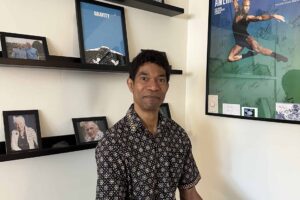
I am Craig Dunham, an Advanced practitioner of the Rolf Method, in practice for 19 years with an office in Santa Monica.
What Rolfing actually is
Rolfing was developed by Dr. Ida P. Rolf, a biochemist who spent decades researching how the body could be brought into better relationship with gravity. Her work, originally called Structural Integration, became known as Rolfing as a term of endearment. The name stuck and would later become a trademark of the Dr. Ida Rolf Institute.
The work is organized around a central idea Dr. Rolf called the Line — a vertical axis through the body that, when the human structure is organized around it, allows for length, ease, and efficient movement in gravity. Practitioners are trained to read structure as a whole and work toward that organization rather than chasing individual symptoms.
It is typically delivered in a series, most often the classical 10-Series, with each session building on the last.
Working with fascia, organizing in gravity
Fascia is the connective tissue that wraps every muscle, bone, organ, and nerve in your body. It is one continuous web. When fascia is healthy and hydrated, your body moves as a unified whole. When it gets bound, dehydrated, or pulled out of place by injury, repetition, or chronic holding patterns, your structure compensates — and those compensations are what most people experience as tightness, restriction, or pain.
Rolfing works directly with fascia, using slow, specific contact to invite the tissue to release and reorganize. The result is not a temporary loosening but a structural shift: the body learns a new way of organizing itself in gravity. Clients often leave the table standing taller, breathing more easily, and moving with less effort.
How it differs from massage
Massage is generally about relaxation and short-term relief. The work is done to you while you rest. Rolfing is structural and participatory. You are an active part of the session — breathing, moving, sometimes standing or walking — while I work with specific layers of fascia to change how your structure organizes itself.
Massage feels good in the moment. Rolfing changes how you feel in your body weeks and years later. Both have their place. They are not the same work.
Why people come to this work
Some come for chronic pain that has not resolved with other approaches. Some come for posture, performance, or recovery from injury. Some come because they want to inhabit their body differently — more present, more upright, more at ease. The work is not for everyone, but the people it is for tend to know it when they feel it.
A note on pain
Rolfing has a reputation for being intense. The honest answer is that it can ask something of you, but the kind of intensity is often not what people expect. I wrote a separate post on this — Does Rolfing Hurt? — that addresses it directly.
Learn more
This page is an introduction. For a fuller explanation of the Rolf Method of Structural Integration — its history, its principles, what a session and a series look like, and how it differs from related modalities — see my main page on the work: The Rolf Method of Structural Integration.
Frequently asked questions
Is Rolfing the same as Structural Integration? Rolfing is the brand name for the Structural Integration work developed by Dr. Ida Rolf. All Rolfing is Structural Integration. Not all Structural Integration practitioners can call their work Rolfing. I trained through the Guild for Structural Integration, the lineage that preserves Dr. Rolf’s authentic method.
How many sessions will I need? Most clients do the classical 10-Series, which is designed to systematically work through the whole structure. The decision is ultimately up to you.
Does Rolfing hurt? It can be intense, but the kind of intensity is usually not what people expect. I cover this in detail here: Does Rolfing Hurt?
Is Rolfing covered by insurance? I do not accept insurance, but can provide you with a receipt if you wish to try.
Where is your office? My office is in Santa Monica, serving clients from across Los Angeles.
Ready to experience the work?
If you are curious about Rolfing in Los Angeles, the best way to understand it is to feel it.
Book a session in Santa Monica.
Rolfing is a trademark of the Dr. Ida Rolf Institute. Craig Dunham is an Advanced practitioner and graduate of the Guild for Structural Integration and practices the Rolf Method of Structural Integration in Los Angeles and Santa Monica.